Wednesday, February 1, 2012

Lovegreen Risk Management Celebrates 10 Years of Service!


Thank you for your continued support of Lovegreen Risk Management. In just 10 years we have grown into the only full service machine guarding company.

Our unique machine guarding approach incorporates Certified Millwrights, Control Integrators and Licensed Electricians working in partnership with our guarding experts to complete your machine guarding projects in a professional and timely manner.

We are excited to achieve this milestone and could not have done it without your support, and the guidance and experience of our parent company Lovegreen Industrial Services. Lovegreen Industrial Services has been in business since 1948 (over 6 decades!) providing world class Millwright services and state of the art fabrication and machining services.


Your machine guarding projects deserve the level of experience we provide to help you protect your workers and comply with regulatory standards. In addition to providing turn-key machine guarding project assistance, we also offer the following services:
  • Machine Guarding Assessments - We will evaluate your machines and create a confidential, detailed report outlining safety issues found and possible solutions.
  • Guarding Design and Engineering - We engineer custom machine guarding solutions that function like O.E.M. components.
  • Custom Guarding Fabrication - We have a 45,000 square foot manufacturing facility to fabricate custom and off the shelf guards and shields.
  • Machine Guarding Installation -We travel to your location to install machine guards and shields.
  • Complete Integration Services - We design and install electrical safety systems that integrate into existing machine controls.
  • Complete Electrical Services - We design and install safety-rated electrical control systems.
  • Online and Catalog offerings of Machine Guarding products - We have a huge assortment of machine safety products that you can purchase and install yourself.
Right now is a good time to take a close look at the effectiveness of your machine guarding program. OSHA has announced a renewed emphasis on enforcement of their regulations.


If you don't have the time or resources to assess your machines, please give us a call. Our experienced safety consultants can visit your facility and do the work for you.
Sincerely,


Frank Schmidt
Lovegreen Risk Management
800-262-8284
http://www.lovegreen.com

Wednesday, January 11, 2012

STEEL MESH EJECTION CURTAIN SAVES 2 FROM INJURY!

An object that ejects from a hydraulic press can become a deadly projectile and cause serious injury if it hits the machine operator or another bystander. Recently, a part was ejected from a 50 ton press at one of our customer's facilities.

The following is the unsolicited testimonial that he sent us.
"Yesterday two people working for us were using our 50 Ton press when the object they were pressing broke and was ejected at speed from the press. Fortunately one of your screens was in place saving them from injury. Just thought I'd let you know your product was a very valuable safety precaution for us and it worked as advertised and saved our people from harm." L.G. December 8, 2011
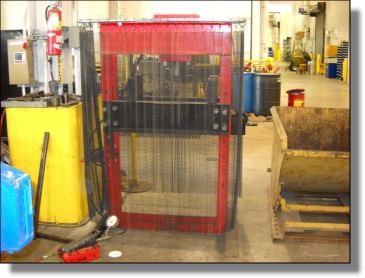
The screen he referred to was in fact a Lovegreen Steel Mesh Ejection Curtain. The curtains are fabricated from Cascade Coil Defense steel mesh. Originally intended to protect people in the vicinity of a bomb blast, this product makes the workplace environment safer.

Installing a steel mesh curtain allow easy access to machines while providing a lower cost method of meeting hydraulic press guarding standards. Because the mesh is black, the press operator's eyes can easily focus on the point of operation. The curtains are lightweight, easy to install, maintenance free and allow natural light visibility. More About the Steel Curtain

For more information, please email or please give me a call.

Frank Schmidt
800-262-8284
fschmidt@lovegreen.com

www.lovegreen.com

Tuesday, December 6, 2011

OSHA educational videos show how to protect workers from construction hazards

Every year in the U.S. more than 800 construction workers die and nearly 137,000 are seriously injured while on the job. Construction workers engage in many activities that may expose them to serious hazards, such as falling from rooftops, unguarded machinery, being struck by heavy construction equipment, electrocutions, silica dust, and asbestos.

OSHA has released 12 educational videos about potential hazards in the construction industry. The educational videos are brief, easy to understand, and geared to the needs of employers and workers. One in every five workers killed on the job nationwide is in construction-totaling nearly 800 construction worker deaths every year.

The videos are based on real-life incidents and include detailed depictions of hazards and the safety measures that would have prevented these injuries and fatalities. OSHA's videos cover falls in construction, workers who are struck by vehicles and heavy equipment, sprains and strains, trenching and excavation hazards, and carbon monoxide poisoning.

View the Construction Hazards Prevention Videos

For more information, please email or please give me a call.


Frank Schmidt
800-262-8284

fschmidt@lovegreen.com

http://www.lovegreen.com/

Friday, November 11, 2011

Control of Hazardous Energy (Lockout/Tagout)

According to the OSHA website, "Lockout/Tagout (LOTO)" refers to specific practices and procedures to safeguard employees from the unexpected energization or startup of machinery and equipment, or the release of hazardous energy during service or maintenance activities.

Compliance with the lockout/tagout standard (29 CFR 1910.147) prevents an estimated 120 fatalities and 50,000 injuries each year. Workers injured on the job from exposure to hazardous energy lose an average of 24 workdays for recuperation.

In a study conducted by the United Auto Workers (UAW), 20% of the fatalities (83 of 414) that occurred among their members between 1973 and 1995 were attributed to inadequate hazardous energy control procedures specifically, lockout/tagout procedures.

OSHA has developed a Lockout-Tagout Interactive Training Program to expand your knowledge of the LOTO standard.

The program has three major components. You can go through these components at your own pace and in any sequence:
  • Tutorial: Explains the standard in a question/answer format.
  • Hot topics: Contains five abstracts with a detailed discussion of major issues. Relevant highlighted sections of the all-inclusive documents are linked here.
  • Interactive case studies: Seven simulated LOTO inspections are presented. You will be making decisions on the application of the LOTO standard, based on information presented on the screen.
The OSHA Lockout-Tagout Interactive Training Program may be found in its entirety at the OSHA Website. It explains what a job hazard analysis is and offers guidelines to help you conduct your own step-by-step analysis.

For more information about Lockout-Tagout services, or to discuss your machine safeguarding needs, please contact me at fschmidt@lovegreen.com or by calling me at 800-262-8284.

Sincerely,

Frank Schmidt

http://www.lovegreen.com/

Thursday, October 20, 2011

New Protection From Hydraulic Press Hazards

An object that ejects from a hydraulic press can become a deadly projectile and cause serious injury if it hits the machine operator or another bystander. When properly installed, the steel mesh curtain will stop projectiles, safely dropping them to the floor. Originally intended to protect people in the vicinity of a bomb blast, this product makes the workplace environment safer.

View Steel Mesh Ejection Curtain

In the past, guarding a hydraulic press meant installing expensive, cumbersome doors that interfered with the ability of operators to do their jobs efficiently. Installing our new steel mesh curtains allow easy access to machines while providing a low cost method of meeting hydraulic press guarding standards.

Government safety standards require that machine hazards must either be eliminated or properly guarded. The steel mesh curtains meet or exceed GSA testing standards, providing effective hydraulic press safety as well as government compliance for the workplace. Recent testing certified that the mesh exceeded the ISC/GSA Performance Condition 3b criteria for acceptable levels of protection from glass fragment hazards during an explosion. (GSA-TS01-2003) It also meets the tougher Unified Facilities Criteria (UFC) 4-010-01 standard.

The curtains are fabricated from Cascade Coil Defense steel mesh. When installed on a hydraulic press, the mesh curtain secures at the top but hangs free at the sides and bottom, providing easy access to the machine. The mesh will stop dangerous, flying debris and allow it to fall safely to the ground. Because the mesh is black, the press operator’s eyes can easily focus on the point of operation. The curtains are lightweight, easy to install, maintenance free and allow natural light visibility.

Cascade Coil steel mesh curtains feature interlocking wire coils, which act as individual springs that absorb energy, expand and stretch. The holes in the material allow the pressure of an explosion to go through the mesh while stopping the flying objects that pose a danger.

The product was designed for, and is used in areas with a high likelihood of terrorist attacks. It has proved to be effective protection from flying glass and shattered window frames. Tests reveal that most of the shattered glass and debris lands within two feet of a window covered with a steel mesh curtain. The product has saved lives and decreased injuries in bombing attacks near restaurants and hotels in Israel and in other countries as well.

About Lovegreen - Vernon Lovegreen Sr. founded Lovegreen Industrial Services in 1948, and it remains a family-owned business located in Eagan, MN. The businesses include a Machine Safeguarding Department, Fabrication Facility and Millwright Division. The Lovegreen Risk Management Department has more that 30 years of experience in machine guarding and assists employers in complying with government safety standards and regulations.

To learn how Lovegreen can meet your machine safeguarding needs, please contact Frank Schmidt at fschmidt@lovegreen.com or by calling 800-262-8284.

http://www.lovegreen.com/

Thursday, September 1, 2011

What is a Hazard?


Our back to school issue starts with a pop quiz!

Question: What is a Hazard?

Answer:  A hazard is the potential for harm. In practical terms, a hazard often is associated with a condition or activity that, if left uncontrolled, can result in an injury or illness. Identifying hazards and eliminating or controlling them as early as possible will help prevent injuries and illnesses.

If you answered the question correctly, take a bow and move on to the bonus round. How do you identify and eliminate or control the hazards?

This is one of the most common questions we hear. A safety manager will call us and ask us to help develop an orderly plan to identify hazards before they occur.

OSHA has a free Job Hazard Analysis hand book that is a great resource for employers, supervisors, and employees to analyze their own jobs and recognize workplace hazards so they can identify the hazards. identify uncontrolled hazards, you will take steps to eliminate or reduce them to an acceptable risk level.

The OSHA Job Hazard Analysis handbook may be found in its entirety at the OSHA Website. It explains what a job hazard analysis is and offers guidelines to help you conduct your own step-by-step analysis.


For more information about machine specific training, or to discuss your machine safeguarding needs, please contact me at fschmidt@lovegreen.com or by calling me at 800-262-8284. 

http://www.lovegreen.com/

Monday, August 1, 2011

What Happens Once the Safeguarding is Complete?

Even the best machine guarding system will not be effective without employee approval. The machine operator needs to understand why the guarding was installed and how it will protect them from the inherent hazards.Our experience has taught us that when the workers are included in a machine safeguarding initative, acceptance of the changes is much greater than cases when it is thrust upon them.

Therefore, machine specific training is an important part of any effort to provide safeguarding against machine-related hazards. Each machine operator should receive hands-on safety training that includes the following topics.

Identification of the hazards associated with a particular machine – This includes a review of the point of operation, the power transmission elements and power controls.

Introduction to the installed safeguards – How will the new guards, shields or process controls protect the operator from the identified hazards? What hazards have not been eliminated?

How to use the safeguards – How can the worker operate the machine while the guards are in place? How do the light curtains, interlocks or scanners control the machine functions? Can the machine be run at low speeds while the doors are open?

Who can remove the safeguards and the procedures that must be followed before this happens.

Is a lockout / tagout program required?

What to do if a safeguard is broken , lock, or doesn't work as advertised.

This kind of safety training is necessary for machine operators and maintenance or setup personnel, when any new or altered safeguards are put in service, or when workers are assigned to a new machine or operation.

Lovegreen Risk Management offers safety training programs, classes and resources to help you understand and comply with government regulations, including OSHA and ANSI. We offer specialized training programs that meet your specific needs.

For more information about machine specific training, or to discuss your machine safeguarding needs, please contact me at
fschmidt@lovegreen.com or by calling me at 800-262-8284.